
A supplier's certificate of analysis can confirm what was tested in a Policosanol raw-material lot. It cannot, by itself, confirm the milligrams of Policosanol in each serving of a tablet, softgel or oil blend. That second number depends on a chain of decisions made after the ingredient arrives: the assay definition, weighed input, processing, representative sampling and a finished-product test suited to the actual formulation. For ingredient buyers, the useful question is where those records meet.
A 2025 study in Food Production, Processing and Nutrition measured five commercial Policosanol supplements sourced in Thailand and the United States. Only two contained the amount expected from their labels; the other three had lower measured amounts. The products were purchased in 2022, and the study did not test Sifeng Bio's SF-001 Policosanol. Nor did it establish one common cause for the differences. Its value here is narrower and more useful: it shows why a label claim should be checked in the final matrix rather than inferred from an ingredient specification.
Policosanol is a mixture of long-chain primary alcohols. The defined set and measurement basis behind a reported “total Policosanol” figure matter; an individual alcohol such as octacosanol is a different analytical question. We explored that distinction in an earlier Policosanol–Octacosanol article. Here, the focus moves downstream to the amount that can actually be substantiated per serving.
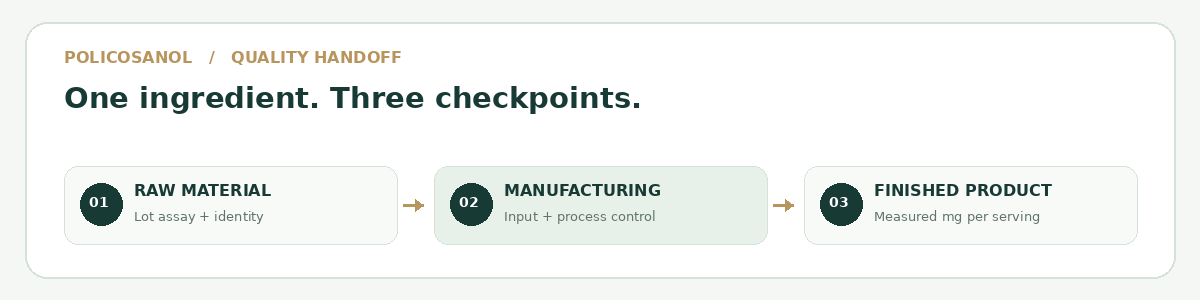
A workable qualification record follows the same material through five stages. Each stage answers a different question; none can substitute for the next one.
| Checkpoint | Evidence to retain | Decision it supports |
|---|---|---|
| 1. Incoming lot | Identity, source, lot number, defined assay, method and relevant contaminant limits. | Can this specific ingredient lot be released against the agreed specification? |
| 2. Formula input | Target mg per serving, assay-adjusted input and documented weighing. | Does the theoretical material balance match the proposed label amount? |
| 3. Processing | Mixing sequence, hold conditions, transfer records and process yield. | Did the process change distribution or recoverable amount? |
| 4. Finished-product test | Representative samples, matrix extraction, recovery and measured concentration. | What amount is measured in the actual product and serving size? |
| 5. Shelf-life review | Product-specific stability plan, packaging and time-point results. | Does the declared amount remain supported over the proposed shelf life? |
Illustrative input calculation: if a hypothetical ingredient has a validated 95% w/w assay for the same defined Policosanol sum, a theoretical 10 mg of that sum requires 10 ÷ 0.95 ≈ 10.53 mg of ingredient per serving before manufacturing.
This is a mass-balance example, not an SF-001 lot specification or an overage recommendation. It does not account for actual process loss, background Policosanol in other ingredients, sampling variation or analytical recovery. The finished product still needs its own measurement.
A discrepancy after production can have several explanations: the input calculation or weighing, uneven distribution, a real processing change, unrepresentative sampling, or incomplete extraction during the analytical test. These are distinct hypotheses. Investigate them in sequence before declaring an ingredient lot at fault or raising the formula input.
The same researchers studied a model of Policosanol-enriched rice bran oil, not every commercial dosage form. For the six-month storage arm, they used nitrogen-flushed amber glass bottles at an ambient 27 ± 5 °C. Under those conditions, the measured Policosanol level in the control oil and one enriched oil did not differ significantly from the initial level after six months, although intermediate readings varied. Heat experiments were separate. These details matter more than the shorthand “Policosanol is stable.”
HUZHOU SIFENG BIOCHEM CO., LTD lists SF-001 Policosanol (CAS 142583-61-7) on its English website. Before trial production, request a current written specification and a representative batch COA, then agree with the finished-product manufacturer on the analyte definition and method. The company's public pages currently display different grade ranges for SF-001; the current offer and lot documents should govern any commercial specification.

State your intended dosage form and market, target Policosanol definition and per-serving amount, desired raw-material source, planned batch size, packaging conditions and the documents required for your qualification. Ask for the assay method and relevant homolog profile, then use pilot lots to agree on a finished-product test and acceptance criteria.
For current SF-001 documentation and sample discussions: Policosanol product page · sales@sifengbio.com · +86-572-2576818 · Contact Sifeng Bio.
Author statement: Prepared by HUZHOU SIFENG BIOCHEM CO., LTD for ingredient-industry communication. The cited commercial-product findings and oil stability data are independent research, not tests of Sifeng Bio materials or customer formulations. The calculation is a hypothetical example. This article makes no treatment claim and does not determine regulatory status or finished-product shelf life; validate the current lot specification and local requirements before use.
Topics: #Policosanol #IngredientQualification #CertificateOfAnalysis #FinishedProductTesting #LabelClaim #NutraceuticalFormulation #BatchConsistency #B2BSourcing